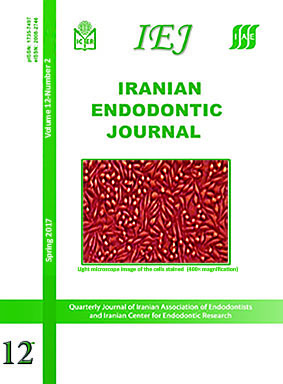
Cytotoxicity of Selected Nanoparticles on Human Dental Pulp Stem Cells
Iranian Endodontic Journal,
Vol. 12 No. 2 (2017),
28 March 2017
,
Page 137-142
https://doi.org/10.22037/iej.v12i2.13437
Abstract
Introduction: Nanoparticles are being increasingly applied in dentistry due to their antimicrobial and mechanical properties. This in vitro study aimed to assess and compare the cytotoxicity of four metal oxide nanoparticles (TiO2, SiO2, ZnO, and Al2O3) on human dental pulp stem cells. Methods and Materials: Four suspension with different concentrations (25, 50, 75, 100 µg/mL) of each nanoparticle were prepared and placed into cavities of three 96-well plates (containing 1×10⁴ cells per well that were seeded 24 earlier). All specimens were incubated in a humidified incubator with 5% CO2 at 37°C. Mosmann’s Tetrazolium Toxicity (MTT) assay was used to determine in vitro cytotoxicity of test materials on pulpal stem cells. Cell viability was determined at 24, 48, and 72 h after exposure. Data comparisons were performed using a general linear model for repeated measures and Tukey's post hoc test. The level of significance was set at 0.05. Results: The tested nanoparticles showed variable levels of cytotoxicity and were dose and time dependant. The minimum cell viability was observed in ZnO followed by TiO2, SiO2 and Al2O3. Conclusion: The results demonstrated that cell viability and morphological modifications occurred at the concentration range of 25 to 100 µg/mL and in all nanoparticles. The higher concentration and longer duration of exposure increased cellular death. Our results highlight the need for a more discrete use of nanoparticles for biomedical applications.
Keywords: Cytotoxicity; Dental Pulp Stem Cells; Metal Oxide Nanoparticle
How to Cite
- Abstract Viewed: 438 times
- PDF Downloaded: 286 times
Download Statastics
Make a Submission
Information
Developed By
Indexing/Abstracting
This journal is indexed in:
- PubMed
- Europe PMC
- Scopus
- SCImago
- MIAR
- CINAHL
- CAS (Chemical Abstracts)
- Dimensions
- DOAJ
- EBSCO
- FATCAT
- Google Scholar
- IMEMR (Index Medicus for the WHO Eastern Mediterranean Region)
- Index Copernicus
- ISC (Islamic World Science Citation Center)
- Magiran
- ROAD
- SID (Scientific Information Database)
- SUDOC
- UC Santa Barbara University
- WIKIDATA
- ZDB


