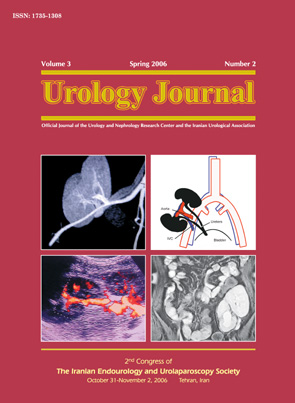
En Bloc Kidney Transplantation from Pediatric Cadaveric Donors to Adult Recipients
Urology Journal,
Vol. 3 No. 2 (2006),
1 March 2009
,
Page 82-86
https://doi.org/10.22037/uj.v3i2.200
Abstract
Introduction: The shortage of cadaveric donors for kidney transplantation has led to the expansion of the criteria used for donor selection, such as the use of pediatric cadaveric donors. In this study we reviewed our results of en bloc kidney transplantation of pediatric cadaveric donors to adults.
Materials and Methods: From May 2001 to May 2005, 245 cadaveric kidney transplants have been performed in our hospitals. Seven of these were en bloc kidney transplantations in adult recipients from marginal pediatric donors (age < 5 years, donor weight < 15 kg, high creatinine clearance, or kidney length < 8 cm). We reviewed their records. Follow-up (range, 3 to 24 months) included ultrasonography, dimercaptosuccinic acid renal scintigraphy, and magnetic resonance imaging.
Results: Serum levels of creatinine ranged between 0.8 m/dL to 1.9 mg/dL during the follow-up period. Â One patient died of myocardial infarction 3 months postoperatively. One-year graft and patient survivals were both 85.7%. Complications included acute tubular necrosis in 1 patient (managed by conservative therapy and dialysis for 2 weeks), renal vein thrombosis in 1 (treated by anticoagulation), and subcutaneous hematoma in 1. There were no urologic complications. Median size of the grafts was 7.2 cm preoperatively that reached 9.6 cm, 3 months postoperatively (P = .018). Twelve months following operation, the median size of the grafts reached 11 cm (P = .045).
Conclusion:Â En bloc pediatric kidney transplantation is a safe and suitable alternative for adult recipients. One-year graft and patient survivals are acceptable and complication rate is low.
How to Cite
- Abstract Viewed: 340 times
- PDF Downloaded: 310 times