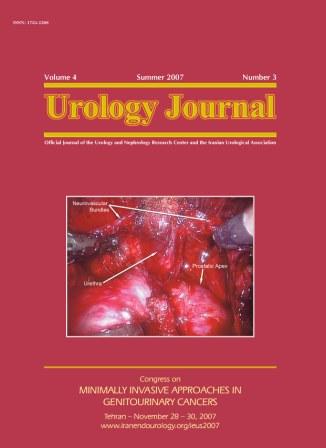
Minimally Invasive Approaches to Prostate Cancer: A Review of the Current Literature
Urology Journal,
Vol. 4 No. 3 (2007),
14 February 2009
,
Page 130-137
https://doi.org/10.22037/uj.v4i3.111
Abstract
Introduction: While radical retropubic prostatectomy has been the gold standard surgical approach, the explosion of minimally invasive methods has led to the search for less invasive treatment options. We offer an overview of the evolution of laparoscopic radical prostatectomy (LRP) and robot-assisted laparoscopic prostatectomy (RALP) in terms of the landmark publications and recent head-to-head comparisons, and we review our own experience.
Materials and Methods: A Medline search was performed using the keywords prostate cancer, prostatectomy, laparoscopic, and robotic. All pertinent articles concerning localized prostate cancer were reviewed. The Montefiore experience consisted of a retrospective review of a prospectively maintained confidential database.
Results: Several laparoscopic and robotic series were identified including review articles of each modality as well as studies directly comparing the two. Both LRP and RALP compare very favorably with conventional open surgery in terms of safety and oncologic efficacy. Both minimally invasive approaches offer decreased blood loss, transfusion rate, and length of hospital stay when contrasted with open surgery. When compared directly, LRP and RALP offer similar surgical, oncologic, and functional outcomes. However, RALP likely requires a shorter learning curve.
Conclusion: The use of minimally invasive techniques has revolutionized the surgical treatment of prostate cancer. Pure LRP has been shown to be feasible and reproducible. However, it has a steep learning curve and is difficult to learn. In contrast, RALP is easier to learn and is now the surgical treatment of choice in most centers of excellence in the United States. The superior optics with respect to visualization and magnification translates into a procedure that is equivalent, if not superior, with respect to perioperative parameters, oncologic outcomes, and functional outcomes to its open counterpart.
How to Cite
- Abstract Viewed: 388 times
- PDF Downloaded: 514 times