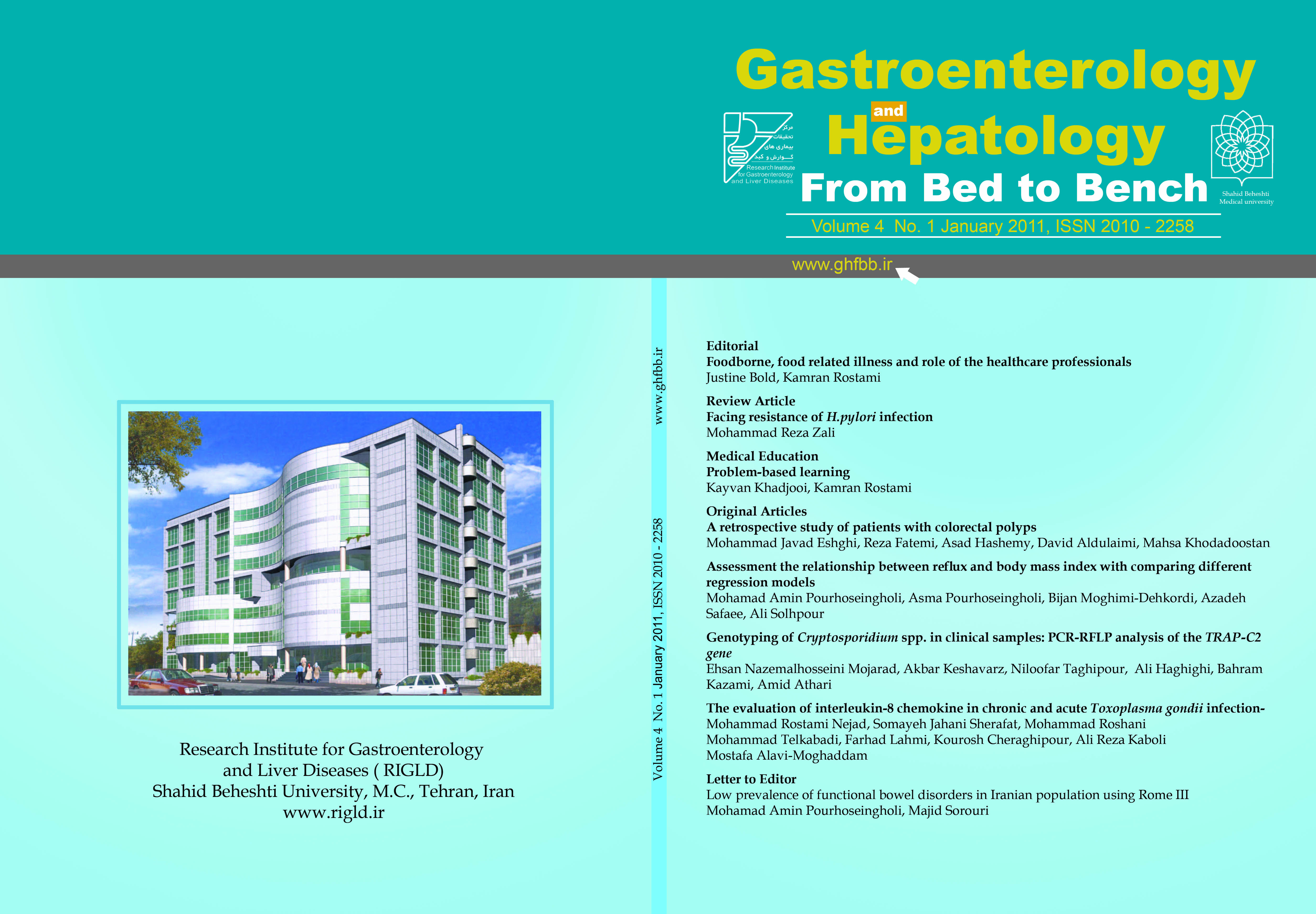
Publisher: Research Institute for Gastroenterology and Liver Diseases (RIGLD)
  • Register
  • Login

Gastroenterology and Hepatology from Bed to Bench

  • Home
  • Issues
    • Current
    • Archives
  • About
    • About the Journal
    • Aims and Scope
    • Editorial Team
    • Privacy Statement
    • Contact
  • For Authors
    • Submissions
    • Author Guidelines
    • Article Processing Charge
    • Peer Review Process
  • Indexing & Abstracting
  • Announcements
Advanced Search
  1. Home
  2. Archives
  3. Vol. 4 No. 1 (2011): Winter
  4. New Section Title Here

Vol. 4 No. 1 (2011)

December 2010

Genotyping of Cryptosporidium spp. in clinical samples: PCR-RFLP analysis of the TRAP-C2 gene

  • Ehsan Nazemalhosseini Mojarad
  • Akbar Keshavarz
  • Niloofar Taghipour
  • Ali Haghighi
  • Bahram Kazemi
  • Amid Athari

Gastroenterology and Hepatology from Bed to Bench, Vol. 4 No. 1 (2011), 29 December 2010
https://doi.org/10.22037/ghfbb.v4i1.133 Published: 2010-12-29

  • View Article
  • Download
  • Cite
  • Statastics
  • Share

Abstract

Aim: The aim of the present study was to determine the species and genotypes of Cryptosporidium spp. among children with diarrhea by PCR- RFLP using the TRAP-C2 gene.

Background: Cryptosporidium is a globally distributed protozoan parasite and one of the most common causes of infection and diarrhea in humans.

Patients and methods: Four hundred and sixty nine stool samples were collected from children less than 12 years with diarrhea who had been referred to Pediatrics Medical Centers in Gazvin provinces. The presence of Cryptosporidium oocysts was determined by Ziehl-Neelsen acid fast staining, then, genomic DNA was extracted from positive samples and nested PCR-RFLP was performed to amplify the TRAP-C2 gene.

Results: The overall prevalence of Cryptosporidium infection in children was 2.5 %. Results of nested PCR amplification showed that of 12 positive children samples, 10 (83.3%) were belonged to C. parvum, followed by C. hominis in 1 (8.3%) and mixed infection in 1 isolate (8.3%).

Conclusion: This study showed that Cryptosporidium parvum (the zoonotic genotypes) is more prevalent than other Cryptosporidium species in children from this area. This suggests that zoonotic transmission is the main mode of transmission of Cryptosporidium infection in Iran.
Keywords:
  • Cryptosporidium
  • Genotypes
  • TRAP-C2 gene
  • PDF

How to Cite

Nazemalhosseini Mojarad, E., Keshavarz, A., Taghipour, N., Haghighi, A., Kazemi, B., & Athari, A. (2010). Genotyping of Cryptosporidium spp. in clinical samples: PCR-RFLP analysis of the TRAP-C2 gene. Gastroenterology and Hepatology from Bed to Bench, 4(1). https://doi.org/10.22037/ghfbb.v4i1.133
  • ACM
  • ACS
  • APA
  • ABNT
  • Chicago
  • Harvard
  • IEEE
  • MLA
  • Turabian
  • Vancouver
  • Endnote/Zotero/Mendeley (RIS)
  • BibTeX
  • Abstract Viewed: 265 times
  • PDF Downloaded: 385 times

Download Statastics

  • Linkedin
  • Twitter
  • Facebook
  • Google Plus
  • Telegram

Developed By

Open Journal Systems
  • Home
  • Archives
  • Submissions
  • About the Journal
  • Editorial Team
  • Contact

GHFBB journal is distributed under the terms of the Creative Commons Attribution-NonCommercial 4.0 International License (CC BY-NC 4.0).

Print ISSN: 2008-2258
Online ISSN: 2008-4234

Support Contact: ghfbb.journal@gmail.com

Powered by OJSPlus